Showing posts with label Dynamic Time Warping. Show all posts
Thursday, July 7, 2016
Using Fault Detection to Help Increase Process Understanding
We released our Batch Analytics (BA) application with
version 12 of DeltaV and provided some additional enhancements as part of
version 13. BA uses Multivariate Analysis
and Dynamic Time Warping to detect process faults, the reasons for those
faults, and predicts endpoint quality, all in real time. So instead of having to wait until the batch
completes to find out there was a problem, fault and quality issues can be
examined while the batch is still running.
This allows operations and engineering personnel to make better decisions
that could correct a quality issue, dump a bad batch early, or schedule
maintenance for when a unit is not in use.
Another important benefit is the education of
inexperienced personnel to gain process understanding. One of the features of the fault detection
screen within BA is to prioritize parameters that are contributing to a fault:
The small green band at the bottom of the screen is the
normalized range of the two fault parameters, T2 and Q. A fault in this range (0 to 1) is
statistically insignificant. The larger
the fault peak (the large blue T2 peak is around 55), the more statistically
significant the fault is. By selecting
the user-friendly parameter names on the left, response plots of actual versus modeled
are displayed:
The black lines above are the actual parameter response,
while the dashed and dotted blue lines are the expected, modeled response. For instance, you can see that M1 Level didn’t
increase as much as the model thought it should have and the Salt Bin Level
didn’t drop as much as the model predicted it should have.
But you don’t have to have a fault to monitor actual
versus modeled trajectories. Here’s a
fault detection screen from a normal batch:
You’ll notice that while some of the peaks exceed the normalized
0 to 1 range, the largest fault is less than 2.5, compared to the 55 on the
previous example. My point is you can
still see the parameters on the left hand side and can plot out their actual
versus modeled response:
Notice that the mixer and salt bin levels followed the
predicted, modeled response. This can
provide a great tool for training operations personnel to understand what “normal”
is to be better prepared for process upsets and faults.
Labels:
Batch Analytics,
DeltaV,
Dynamic Time Warping,
multivariate
Thursday, September 30, 2010
Prime Time Batch Analytics
I mentioned last week that I was helping out at the Emerson Exchange during the technology exhibits for DeltaV Batch. And while we had good traffic from customers (despite my tag as a booth babe), the two areas on either side of us were packed. To the left was the Syncade area where folks were 2 and 3 deep waiting to get a chance to see both the current offerings and soon to be released version 5.3.
To the right was the Advanced Control area, and specifically, the Batch Analytics tool. Emerson announced during Exchange that Batch Analytics will be part of the version 12 release of DeltaV. Coupled with its PAT implications, Batch Analytics promises to be a game changer in the batch process control world.
I’ve been following the development of the Batch Analytics tool for almost 4 years now. And while the discussions about its PCA, PLS, and Dynamic Time Warping components are better left to Terry Blevins, David Rehbein, and Chris Worek, I feel I’m qualified to talk about the Batch Analytics interface app for the iPad.
It is so cool! Paul Muston from Emerson in England did the development work and I nagged enough folks to get the first version installed on my iPod Touch, and then the enhanced iPad compatible app this past May (to be fair, I bought the iPad as a mother’s day present to my wife – she proceeded to get me diamond studded earrings for father’s day).
Below you’ll find some iPad screenshots of the fault detection, endpoint quality, and contribution screens. I’ve also posted a video on my YouTube channel showing the iPhone version running on my iPad.
Wednesday, May 26, 2010
WBF 2010 Conference
I’ve spent the last few days in Austin attending the WBF 2010 Conference. This is my 4th WBF Conference, and my first impressions were is was a shame there were not more folks in attendance and the imbalance between suppliers (vendors and integrators) and end users. The economy is still taking its toll, and that’s too bad, considering the standard and guideline development used throughout the continuous, batch, and discrete manufacturing industries happens because of the WBF and ISA. I hope the WBF will make the presentations available to everyone on their web site.
The content was excellent, and covered the spectrum from S88 implementation suggestions to full blown S95 factory floor to ERP solutions. There was a lot of conversation about the ISA 106 standard, which covers procedures for automating continuous processes. After you re-read that last sentence and think I’ve eaten too much brisket (BTW, you can never eat too much brisket), what 106 is addressing are all those procedures that continuous processes rely on for making grade changes, distillation train start ups, etc. Right now it’s all in the heads of senior operators (and probably no two do it the same way), and oh yeah, those operators are retiring in droves. We’ve almost come full circle with 106 from the early days of S88.
Both days keynote speakers (Dr. Tom Edger of the University of Texas and Dr. J. Patrick Kennedy, founder of OSIsoft), talked about our upcoming energy challenges from a controls point of view. And since both are Kansas grads, they know what they’re talking about.
Of course I had a special interest in the presentation on Batch Analytics given by Bob Wojewodka of Lubrizol and Dawn Marruchella of Emerson. They described the results of the real time batch analytics field trial at a Lubrizol facility in France. Even the moderator of the session was impressed – he told us that when he goes home tonight and his son asks him what he heard today, he’ll be able to tell him about Dynamic Time Warping. His son will think he’s cool.
And after a couple of grueling days, it was nice to take in a ball game at the Dell Diamond with Todd Maras of Emerson. It was a great night in central Texas.
Labels:
DeltaV S88 S95 Batch,
Dynamic Time Warping,
Emerson,
WBF
Thursday, October 1, 2009
Going Bolding at Emerson Exchange 2009
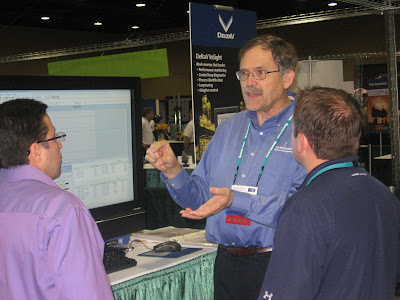
I’ve known Terry Blevins for years and if I was only half as smart as he is, I’d be happy. Terry was manning the Advanced Process Control booth at Emerson Exchange and he was demonstrating something he’s been working on for 3 years now – Online Batch Process Analytics.

So for the first time in a process automation system, there’s a tool to monitor the quality and predict the endpoint of a batch based on a PCA/PLS developed model. He implemented a really cool technique call Dynamic Time Warping (beam me up, Scotty) which is based on logic used in voice recognition software to remove the time variation in batch to batch runs in developing the models.
Through a presentation layer making use of Microsoft Silverlight, operations and engineering personnel can then monitor, via Internet Explorer, the progression of a batch in real time and not only identify deviations, but quickly determine if the variations will effect the overall batch quality based of critical quality parameters.
Subscribe to:
Posts (Atom)